
 Zhejiang wanlai Intelligent electric co., ltd.


RCBO: Electronic vs Electromagnetic
Choosing between an Electronic RCBO (Residual Current Breaker with Overload) and an Electromagnetic RCBO is vital as it plays an important role in the safety and reliability of electrical circuits. The information provided in this article will help you understand what these devices are, how they work, what are their main functions, and help you choose the right RCBO for your purpose.
What Is an RCBO?
An RCBO, or Residual Current Circuit Breaker with Overcurrent protection, plays the role both of an MCB, or Miniature Circuit Breaker, and that of an RCD, or Residual Current Device. It provides protection from both earth leakage (which prevents shocks and fire) and overcurrent (which helps avoid overloads and short circuits) through a single device.
How Does an RCBO Work?
RCBOs continuously monitor the electrical flow in a circuit. When they detect abnormal current flows, such as earth leakage or an overload, they instantly disconnect the circuit. This dual protection makes RCBOs an essential part of modern electrical safety systems.
Types of RCBOs: Electronic vs. Electromagnetic
There are two main types of RCBOs: electronic and electromagnetic types, which operate differently and have various advantages.
Electronic RCBO
Electronic RCBOs like JCB2LE-80M RCBO , Utilizing the microchip technology and electronic being able to sense fault leakage currents, these devices give a high degree of sensitivity, with the capability to detect minute leakage currents. Electronic RCBOs are widely used in controlled environments where power supply stability is guaranteed, and auxiliary power is readily available.

Electromagnetic RCBO
Electromagnetic RCBOs like JCR2-63 RCBO . The technology is known to be strong and reliable with a minimal effect of electrical disturbances due to various events such as changes in temperature and voltage levels. Electromagnetic RCBOs are ideal for applications requiring high reliability, environmental resilience, and auxiliary power independence.
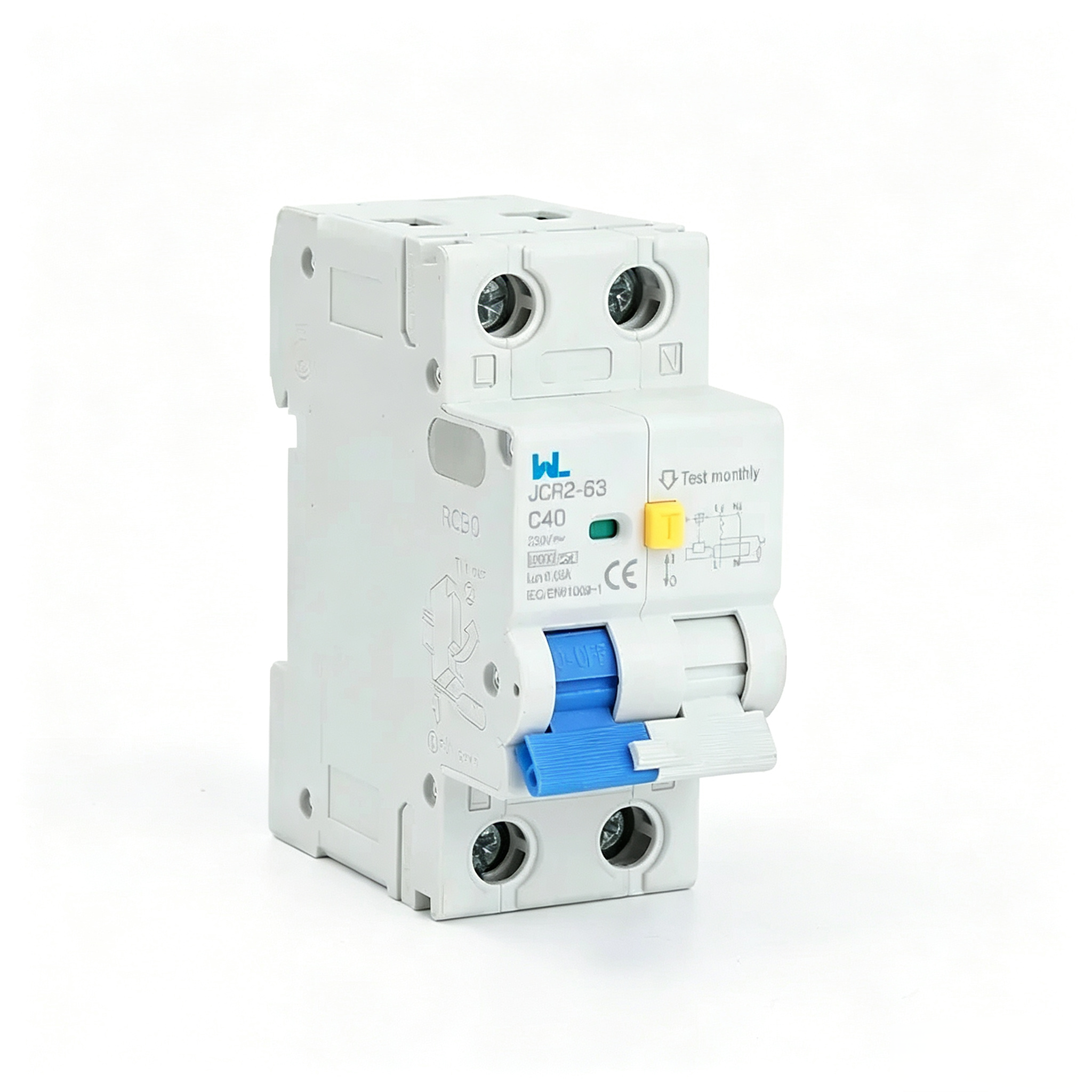
Electronic RCBO vs. Electromagnetic RCBO: Key Differences Table
| Feature | Electronic RCBO | Electromagnetic RCBO |
| Mechanism | Uses an electronic amplifier/circuit board to amplify the signal from the zero-current transformer and trigger a thyristor or transistor switch. | Uses a zero-current transformer whose secondary winding is connected directly to a polarized relay or magnetic latch trip actuator. |
| Manufacturing & Cost | Simpler build; more affordable and compact | More complex build; typically higher cost |
| Anti-Interference & Shock | Lower immunity; can be sensitive to surges. | High immunity to electrical noise/transients. |
| Reliability | If the supply voltage drops too low, or if the phase/neutral line is lost or severed during a fault, leakage protection can fail or be lost, creating a potential shock hazard. | Operates independently of supply voltage fluctuations, voltage loss, or broken neutral/phase conditions (as long as the residual current loop is intact). |
| Resilience | susceptible to damage from voltage surges, EMI, extreme temperatures, and humidity-induced corrosion. | They tolerate voltage spikes and transient surges much better over a long service life. |
| Power Dependency | Requires a live line voltage or auxiliary supply to power the internal electronic circuit. | Does not require line voltage or an auxiliary power supply to trip. The energy from the residual (leakage) current itself creates the mechanical force needed to trip the breaker. |
| Example | JCB2LE-80M RCBO | JCR2-63 RCBO |
Applications and Selection Tips
Electronic RCBOs are best suited for:
- Residential Buildings
- Commercial Facilities
- Light Industrial Environments
- Renewable Energy Systems
- Medical Facilities (Non-Critical Areas)
Electromagnetic RCBOs are ideal for:
- Heavy Industrial Environments
- Outdoor and Remote Installations
- Critical Infrastructure
- Marine and Offshore Applications
- Automotive and Transportation
Such as Residential Buildings, Commercial Facilities and so on, both types can meet basic residual‑current protection requirements. You may select electronic RCBOs for lower cost, or electromagnetic RCBOs for stronger immunity to power fluctuation and EMI.
FAQ: Differences Between Electronic RCBO and Electromagnetic RCBO
Q: Which RCBO is safer?
A: Both provide critical residual‑current protection. Electronic RCBOs can detect smaller leakage currents thanks to higher sensitivity, electromagnetic RCBOs maintain leakage protection even without supply voltage, The safer option depends on the installation environment.
Q: Can I use electronic RCBOs outdoors?
A: They function best indoors or in controlled spaces. For unpleasant environments or industrial applications, electromagnetic RCBOs are the preferred type.
Q: Will an electromagnetic RCBO protect smart devices?
A: Yes. Electromagnetic RCBOs can effectively provide residual‑current protection for smart devices. While electronic RCBOs often pair better with smart home systems via digital monitoring functions, electromagnetic RCBOs deliver reliable leakage protection for electronics regardless of smart communication features.
Future Trends
By understanding the key differences outlined in this article, industry professionals can make informed decisions to ensure electrical system safety, efficiency, and long-term performance. For most standard applications, electronic RCBOs offer an optimal balance of cost and functionality; for critical or harsh environments, electromagnetic RCBOs provide the reliability and resilience required to mitigate risks and ensure continuous protection.
- ← Previous:RCCB vs RCBO :Key Differences For Selection
- :Next →


